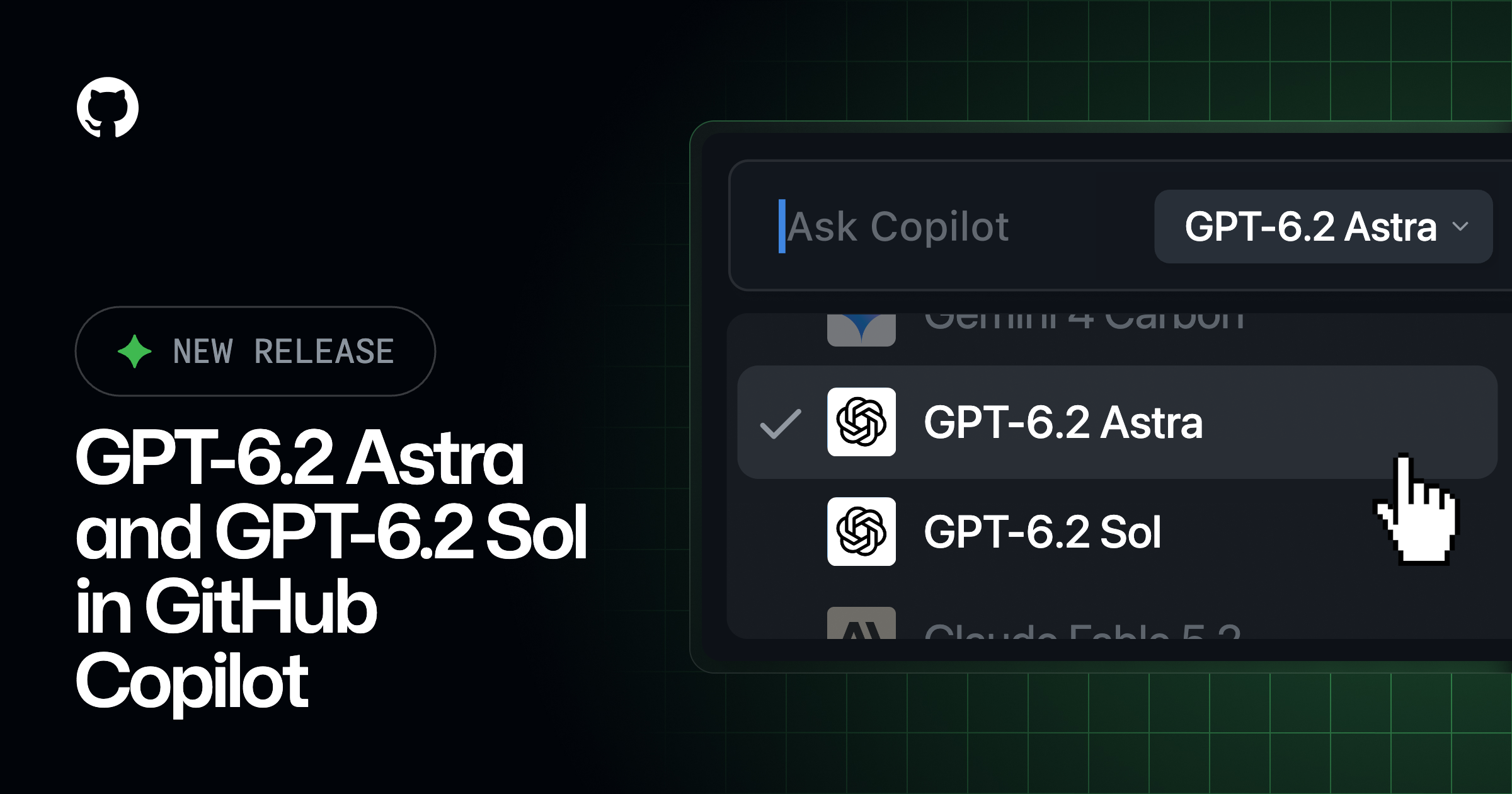
Developers using GitHub Copilot are getting a major upgrade. OpenAI has officially rolled out its newest artificial intelligence models—GPT-6.2 Astra and GPT-6.2 Sol—bringing advanced agentic coding capabilities directly into mainstream software engineering workflows.
Here is a detailed breakdown of what this release means for individual developers, enterprise teams, and the broader software development lifecycle.
What Happened
OpenAI and GitHub have integrated the GPT-6.2 Astra and Sol models directly into the GitHub Copilot ecosystem. Built specifically for complex software development tasks, these models feature vastly enhanced contextual awareness and coding judgment compared to previous iterations.
This release follows months of iterative development in AI-assisted programming, where prior models frequently struggled with multi-file refactoring and context retention. According to early technical evaluation data, the new models caught significantly more real-world logic bugs and security vulnerabilities during code reviews than older GPT-6 baseline versions. Crucially, they achieved this higher accuracy while consuming fewer tokens, making them substantially faster and more cost-effective for continuous integration pipelines.
Availability and Pricing
The models are currently rolling out globally through a phased deployment across multiple tiers. Users subscribed to Copilot Pro+, Max, Business, and Enterprise plans will gain access as the rollout reaches their accounts.
Billing for the new models adheres to standard provider list pricing under a transparent usage-based structure.
- Enterprise & Business Controls: Administrators for organization plans can manage model availability directly through their dashboard settings.
- Default Settings: The new models are enabled automatically by default unless an administrator has explicitly disabled global default overrides or restricted these specific models.
Why It Matters
As AI development tools rapidly shift from simple inline code completion to autonomous agentic workflows, accuracy and token efficiency have become paramount. GPT-6.2 Astra and Sol represent a critical turning point by drastically reducing false positives during automated code reviews.
By catching complex regressions early while lowering overall compute overhead, these models allow engineering teams to ship secure software much faster without inflating operational budgets.
What's Next
As the rollout completes over the coming weeks, attention will turn to how development teams leverage Astra and Sol for autonomous multi-step debugging and repository-wide refactoring. Industry observers expect these efficiency gains to accelerate the adoption of agent-driven development loops across enterprise tech stacks. If you do not yet see the models in your integrated development environment, expect them to appear as the deployment expands.


