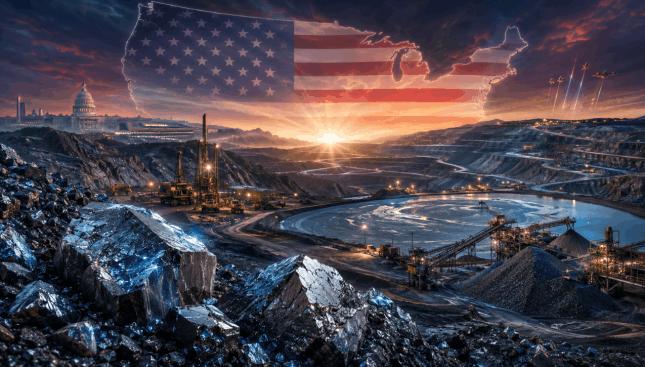
The world is quietly hurtling into a "supercycle" for a metal most people have never heard of: Tungsten. Often overshadowed by flashier commodities like lithium or copper, tungsten is now at the epicenter of a geopolitical showdown, with China tightening its grip on global supply and the United States desperately seeking domestic alternatives for a material deemed critical to national security.
This isn't just about commodity prices; it's about the very sinews of modern industry and defense.
The Tungsten Tsunami: Why Geopolitical Tensions are Fueling Price Explosions
Imagine a metal essential for everything from high-strength drill bits and missile components to advanced electronics and even future-forward electric vehicles. That's tungsten. With the highest melting point of all metals (3,422 °C), its unique properties make it irreplaceable in countless applications.
Here's the kicker: China controls roughly 82% of the world's tungsten production. In December 2024, Beijing implemented new export restrictions on "dual-use" technologies, explicitly including tungsten. The global market reacted instantly: prices surged, stockpiles dwindled, and Western governments began scrambling to shore up strategic reserves.
Consider this staggering fact: a metal once valued at around $8 per pound in project economics is now trading at over $139 per pound. That's a nearly 900% increase, transforming outdated economic assessments into potential goldmines overnight. This dramatic shift highlights not just market scarcity, but a fundamental re-evaluation of supply chain risk.
Why Tungsten is a US National Security Priority
The United States has a major Achilles' heel when it comes to tungsten: it produces virtually none commercially from domestic sources. The entire supply chain hinges on imports, predominantly from the very nation now restricting its flow. This vulnerability hasn't gone unnoticed by Washington. The U.S. Department of Defense (DoD) has officially classified tungsten as a "critical defense material," actively promoting the development of domestic production.
For the Pentagon, reliable access to tungsten isn't merely an economic consideration; it's a matter of strategic autonomy and military readiness. This urgent call for homegrown sources creates an unprecedented opportunity for companies positioned to answer.
Spartan Metals Corp. Steps Up: Unlocking America's Critical Mineral Future
Enter Spartan Metals Corp. (TSX-V: W, OTCQB: SPRMF, FSE: J03). This Canadian explorer has strategically positioned itself as a potential solution to America's tungsten dilemma, evolving rapidly from a single-project explorer to reportedly managing the largest historical tungsten portfolio in the USA. With two flagship projects – Eagle in Nevada and Victorio in New Mexico – Spartan is aggressively pursuing domestic supply.
Eagle Project, Nevada: Drilling into High-Grade Tungsten & Rubidium Potential
The Eagle Tungsten-Silver-Rubidium Project in Nevada is Spartan's spearhead. Spartan Metals Corp. recently announced the launch of its 2026 exploration and drilling program, a pivotal move that could translate geological models into hard data.
Starting with extensive soil and rock sampling on the expanded Tungstonia Claims, the program will rapidly escalate. Early June will see deep-penetrating geophysical surveys (TITAN-MT and DCIP) across the entire project area, designed to trace over two kilometers of known tungsten-silver structures and identify potential skarn zones. The real action kicks off in early to mid-July, with approximately 3,000 meters of diamond core drilling targeting prioritized zones.
Why does this matter? These new efforts are focused on areas where high-grade tungsten, silver, and rubidium anomalies have already been identified. Spartan Metals Corp. reports underground channel samples reaching up to 5.32% WO₃ and rock samples for rubidium showing values up to 2,264 ppm. Some individual silver samples from the CRD zone yielded up to 900 g/t Ag. This indicates serious potential for a significant expansion of the historic Eagle district, which now spans 36.5 km² and includes the historic Yellow Jacket Tungsten Mine.
Rubidium: A Strategic Jackpot Beyond Tungsten?
An unexpected discovery at the Eagle Project could prove to be a strategic game-changer: Rubidium. Often overlooked, this critical mineral is essential for atomic clocks, precision navigation technology, and the next generation of computer chips. The Eagle Project, according to Spartan Metals Corp., could host the largest – and potentially only – economically significant rubidium source in the United States. This adds another layer of geopolitical significance to the project, addressing yet another critical mineral vulnerability.
Victorio Project, New Mexico: Reappraising a US Tungsten Giant
Complementing Eagle, Spartan Metals Corp. secured an option on the Victorio Tungsten-Molybdenum Project in New Mexico in March 2026. This is a monumental acquisition, representing one of North America's most significant tungsten deposits with historically defined resources exceeding 154 million tonnes.
A preliminary economic assessment (PEA) from 2008, based on a tungsten price of roughly $8 per pound, calculated substantial figures for a large-scale underground mining scenario. But here's the crucial detail: the current tungsten price is approximately nine times that original basis. Spartan's CEO, Brett Marsh, has stated that an updated PEA will be a top priority, poised to reflect the project's dramatically enhanced economic potential.
Accelerating Value: Tailings, Strategic Partnerships, and Investor Confidence
Spartan Metals Corp. isn't just looking underground; it's also eyeing near-term opportunities. The company has identified potential early-phase cash flow from the tailings (waste dumps) of the former Tungstonia processing plant. Early assay results from 34 drill holes into these tailings are promising, with a viable processing route potentially generating early cash flow by Q2 2026. This strategy could finance further exploration, reduce development risk, and limit shareholder dilution.
The company's strategic alignment is clear: it aims to be a key partner in the USA's national critical mineral strategy. Spartan is actively exploring funding opportunities through non-dilutive capital sources from US agencies like the Department of Defense (DoD) and the Department of Energy (DoE). CEO Brett Marsh underlines this focus: "The main reason we built the company was to ensure that we are first in line to supply tungsten and other critical metals to the U.S. Department of Defense."
Market sentiment reflects this strategic positioning. An announced C$4.4 million private placement in April 2026 was so oversubscribed that it had to be upsized to C$5.5 million. Furthermore, significant insider ownership, with approximately 70% of outstanding shares held by insiders and strategic investors, signals strong belief in the company's trajectory.
What's Next for America's Tungsten Ambition?
Spartan Metals Corp. currently trades at a fraction of its US tungsten peers, despite reportedly controlling the largest historical tungsten portfolio in the nation. This discrepancy, combined with a tight capital structure, suggests significant upside potential should upcoming catalysts materialize.
Investors are keenly awaiting drill results from the Eagle Project, expected in late Q3 2026, and the updated PEA for the Victorio Project, which could dramatically revalue the asset. As geopolitical tensions simmer and the demand for critical minerals intensifies, companies like Spartan Metals Corp. are not just exploring for resources; they're exploring for strategic independence. The tungsten supercycle isn't just a market phenomenon; it's a testament to the shifting sands of global power and resource control.