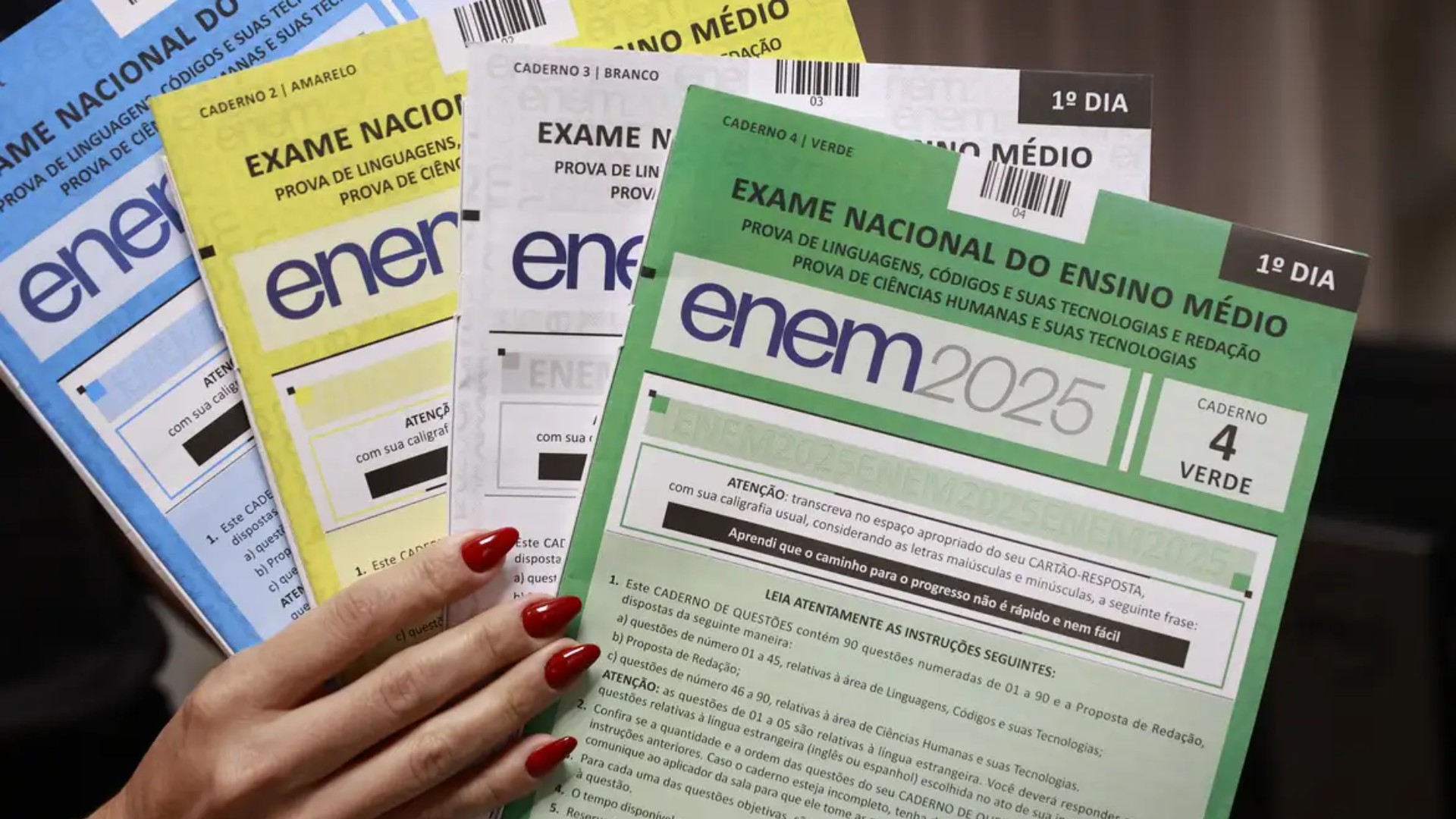
The second and final day of the Exame Nacional do Ensino Médio (Enem) 2026 is officially complete. Millions of candidates across Brazil spent the afternoon completing the STEM-focused portion of the nation’s primary higher education admissions test.
Originally established in 1998 to evaluate high school education standards, Enem has transformed into Brazil’s most critical academic assessment. Scores now serve as the primary gateway to public university admissions, federal scholarships, and student financing across the country.
What Happened on Day Two
The second day focused on hard sciences and quantitative reasoning. Candidates answered 90 multiple-choice questions split across two core areas:
- Mathematics and Its Technologies: 45 questions covering algebra, geometry, data interpretation, and applied math.
- Natural Sciences and Its Technologies: 45 questions spanning Physics, Chemistry, and Biology.
Despite the analytical focus, the exam retained its signature real-world context. Prompts included references to modern digital culture—such as dating apps—alongside classic cultural references like Tarsila do Amaral’s iconic painting Abaporu.
Expert Assessment and Integrity
Education experts evaluated the second-day exam as balanced and consistent. Teachers noted that questions prioritized practical comprehension and analytical reasoning over obscure formulas.
Administrative officials confirmed testing infrastructure remained stable throughout the day. Ministry of Education authorities reported that defense protocols successfully neutralized several cyberattack attempts targeting official testing platforms, ensuring operational continuity and data integrity.
Why It Matters
Enem serves as the largest higher education entrance mechanism in Latin America, directly impacting career trajectories for millions of students:
- Public University Seats: Scores determine acceptance into tuition-free federal and state universities via the Unified Selection System (Sisu).
- Financial Aid & Grants: Programs like ProUni (full and partial scholarships) and FIES (low-interest student loans) require Enem scores as a mandatory eligibility baseline.
- International Pathways: Dozens of international institutions, particularly in Portugal, accept Enem scores for direct undergraduate enrollment.
Checking Results and Scoring Mechanics
Students evaluating their performance have two main options:
- Unofficial Answer Keys: Educational portals and preparatory institutes have published unofficial answer keys (gabarito extraoficial) across all exam booklet colors.
- Official Answer Keys: The National Institute for Educational Studies and Research (Inep) will release official answer keys and exam booklets online.
Final scores rely on Item Response Theory (TRI), a statistical model evaluating question difficulty and consistency in student responses. Because TRI penalizes random guessing, raw answer counts serve only as a preliminary baseline rather than a final score.
What's Next
Inep will publish official answer keys within the coming days. Individual scorecards—combining Day Two STEM scores with Day One language, humanities, and essay results—are scheduled for release in early January 2027, ahead of the national Sisu application window.


